

Cathodic protection is an electrochemical method used to control corrosion of reinforcing steel in reinforced concrete. It is particularly useful where chlorides have already contaminated the concrete and removing all contaminated concrete would be impractical or excessively disruptive.
1. The basic principle
Corrosion of reinforcement is an electrochemical process.
At an anodic area of the reinforcement:
Fe → Fe² ⁺ + 2e ⁻
Iron dissolves and electrons are released. Elsewhere on the reinforcement, a cathodic reaction consumes those electrons, typically involving oxygen and water.
Cathodic protection works by supplying electrical current to the reinforcement so that the steel is maintained at a sufficiently negative electrochemical potential. This suppresses the anodic dissolution of iron and therefore reduces or stops corrosion.
The widget above is not directly representative of the electrochemical mechanism, but the important concept is that cathodic protection is fundamentally about controlling the electrical conditions at the steel/concrete interface, rather than physically removing the chlorides.
2. What happens in reinforced concrete?
A simplified corrosion cell can be represented as:
Anode → electron flow through steel → Cathode
while ionic current flows through the moist concrete.
For corrosion to occur, four things are generally involved:
- An anodic region on the reinforcement.
- A cathodic region on the reinforcement.
- An electrically continuous steel path.
- An ionically conductive concrete environment.
Cathodic protection interferes with this corrosion cell.
The protection system makes the reinforcement the cathode, reducing or preventing further metal dissolution.
3. Two main types of cathodic protection
There are two principal systems used for reinforced concrete:
1. Impressed current cathodic protection — ICCP
An external DC power supply drives current from an installed anode system through the concrete to the reinforcement.
2. Galvanic or sacrificial-anode protection
A more electrically active metal is connected to the reinforcement. The sacrificial metal corrodes preferentially, supplying protective current to the reinforcing steel.
4. Impressed Current Cathodic Protection
An ICCP system typically consists of:
DC power supply → anode → concrete → reinforcing steel → DC power supply
The anode is installed on or within the concrete, while the reinforcing steel acts as the protected cathode.
A simplified arrangement is:
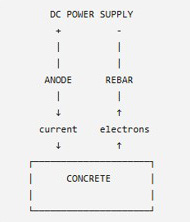
The power supply establishes a controlled potential difference between the anode and reinforcement.
The resulting current passes through the concrete electrolyte and reaches the reinforcing steel.
5. What actually stops the corrosion?
It is important to understand that cathodic protection does not necessarily remove the chloride contamination.
Instead, it changes the electrochemical environment at the reinforcement.
The applied protective current:
- Reduces the anodic corrosion reaction.
- Makes the steel more cathodic.
- Can increase the hydroxyl concentration at the steel surface.
- Helps restore or maintain conditions favourable to passivity.
- Reduces the rate at which iron is dissolved.
Therefore, a chloride-contaminated structure can potentially remain in service without removing all chloride-contaminated concrete.
This is one of the major advantages of cathodic protection.
6. Galvanic Cathodic Protection
A galvanic system uses a sacrificial anode, commonly based on metals such as zinc.
The principle is:
Zinc anode → concrete → reinforcing steel
Zinc is more electrochemically active than steel, so the zinc preferentially corrodes.
The sacrificial anode supplies electrons to the reinforcing steel, reducing its tendency to undergo anodic dissolution.
A simple arrangement is:
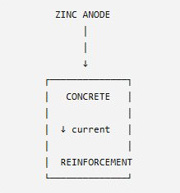
The sacrificial anode is gradually consumed and eventually requires replacement.
7. ICCP versus galvanic systems
| Characteristic | ICCP | Galvanic |
|---|---|---|
| Power source | External DC power supply | Sacrificial anode |
| Current control | High | Limited/self-regulating |
| Output | Can provide relatively high current | Generally lower |
| Monitoring | Extensive monitoring possible | Simpler |
| Anode life | Potentially long | Limited by consumption |
| Maintenance | Power/control system required | Anode replacement required |
| Suitable for severe corrosion | Often suitable | May be limited |
| Installation complexity | Higher | Generally lower |
| Energy requirement | Yes | No external power |
| Control of protection level | High | More limited |
The appropriate system depends on the severity and distribution of corrosion, structural configuration, access and maintenance requirements.
8. What does the anode look like?
The anode system can take several forms.
Depending on the application, anodes may include:
- Titanium mesh.
- Titanium ribbon.
- Conductive coatings.
- Discrete galvanic anodes.
- Linear anodes.
- Embedded anodes.
- Surface-mounted anode systems.
For example, a titanium mesh can be installed across the concrete surface and then covered by a suitable cementitious overlay.
The mesh becomes the anode.
9. Why is this useful for chloride-contaminated structures?
Consider a multi-storey car park.
De-icing salts penetrate the concrete:
Surface → chloride ingress → reinforcement
Eventually the chloride concentration at the reinforcement becomes sufficiently high to destabilise the passive layer.
Corrosion begins.
Normally, a conventional repair might involve:
- Breaking out contaminated concrete.
- Exposing reinforcement.
- Cleaning the steel.
- Replacing severely damaged reinforcement.
- Applying repair material.
- Reinstating the concrete.
However, chlorides can remain outside the repair area.
This creates the possibility of incipient anode formation around the repaired region.
Cathodic protection can be used to control corrosion across a much larger area without necessarily removing all chloride-contaminated concrete.
10. The "incipient anode" problem
This is particularly important when considering cathodic protection versus conventional patch repairs.
Suppose a chloride-contaminated slab has corrosion occurring in one area.
You remove the visibly damaged concrete and repair it.
The adjacent concrete still contains chlorides.
The repaired area may now have relatively clean, passive reinforcement, while the surrounding chloride-contaminated concrete remains capable of supporting corrosion.
The electrochemical balance can change, potentially causing corrosion to develop around the perimeter of the repair.
This is commonly referred to as the incipient anode effect.
Cathodic protection can address this by providing corrosion control over the reinforcement system rather than simply treating isolated visible defects.
11. What does cathodic protection not do?
Cathodic protection should not be viewed as a universal repair solution.
It does not necessarily:
- Restore lost reinforcement section.
- Replace structurally inadequate concrete.
- Repair major structural cracks.
- Restore delaminated concrete.
- Remove chlorides.
- Correct inadequate drainage.
- Stop water ingress by itself.
- Replace waterproofing.
- Correct poor concrete cover.
If reinforcement has already lost significant cross-sectional area, structural assessment and conventional concrete/reinforcement repairs may still be required.
Cathodic protection primarily addresses ongoing electrochemical corrosion.
12. Relationship with waterproofing
This is particularly relevant to the car park deck example you asked about earlier.
A useful way of thinking about the two systems is:
Waterproofing
Prevents future ingress.
Cathodic protection
Controls corrosion that is already occurring.
They can therefore be complementary.
For example:
Existing chloride-contaminated car park
↓
Concrete repair
↓
Cathodic protection
↓
Waterproofing / surface protection
↓
Reduced future chloride and water ingress
The precise sequence depends on the existing condition and selected system.
13. How is the system monitored?
A major advantage of ICCP is that its performance can be monitored.
A typical system may include:
- Reference electrodes.
- Anode zones.
- DC power/control units.
- Monitoring points.
- Reinforcement connections.
- Data logging.
Reference electrodes provide information about the electrochemical condition of the reinforcement.
The system can then be adjusted to provide the required level of protection.
This is important because more current is not necessarily better.
Excessive cathodic protection can produce undesirable effects, including risks associated with hydrogen generation and concrete/steel interface chemistry.
The objective is therefore controlled protection, not maximum current.
14. What is a reference electrode?
A reference electrode provides a stable electrochemical reference against which the reinforcement potential can be measured.
Common systems may use reference electrodes such as:
- Silver/silver chloride.
- Manganese dioxide.
- Other suitable embedded reference systems.
The reference electrodes are installed at representative locations close to the reinforcement.
The monitoring system can then determine whether the reinforcement is receiving adequate protection.
15. How do you know it is working?
Cathodic protection is normally verified through electrochemical measurements rather than simply looking for the disappearance of rust staining.
Typical assessment parameters include:
- Steel potential.
- Instant-off potential.
- Depolarisation response.
- Protective current.
- Anode current.
- Continuity of reinforcement.
- Reference-electrode measurements.
One important concept is depolarisation.
The reinforcement potential is measured after the protective current has been interrupted for a defined period.
The change in potential provides evidence of whether the reinforcement has received adequate cathodic protection.
The acceptance criteria should be established using the applicable standards and project-specific design basis.
16. Why electrical continuity is important
Cathodic protection depends on the reinforcement acting as a connected electrical system.
If reinforcement bars are electrically isolated from one another, parts of the structure may not receive adequate protective current.
Therefore, before installing a cathodic protection system, the engineer normally needs to establish:
- Reinforcement continuity.
- Electrical connections.
- Isolation from unintended metallic components.
- Reinforcement layout.
- Anode zoning.
This can be a significant issue in older structures.
17. Typical application to a car park
For a chloride-contaminated reinforced concrete car park deck, a potential strategy could be:
Existing condition
- Chloride-contaminated slab.
- Active reinforcement corrosion.
- Localised spalling.
- Significant areas of sound-looking but chloride-contaminated concrete.
- Limited ability to close the car park.
Investigation
- Concrete cover survey.
- Chloride profiles.
- Carbonation testing.
- Half-cell potential mapping.
- Reinforcement continuity testing.
- Concrete condition survey.
- Corrosion-rate assessment where required.
Repair
Remove structurally unsound concrete and repair severely deteriorated areas.
↓
Install the cathodic protection system over the designated reinforcement zones.
↓
Install monitoring/reference electrodes.
↓
Commission and adjust the CP system.
↓
Apply suitable concrete protection/waterproofing where required.
↓
Monitor system performance throughout its service life.
This approach can avoid the need to remove all chloride-contaminated concrete where the structural and durability design demonstrates that cathodic protection is an appropriate solution.
18. Cathodic protection versus concrete removal
| Issue | Conventional repair | Cathodic protection |
|---|---|---|
| Removes damaged concrete | Yes | Yes, where necessary |
| Removes all chlorides | Potentially, but difficult | No |
| Controls active corrosion | Locally | Across protected zones |
| Treats hidden corrosion | Limited | Potentially yes |
| Incipient anode risk | Can remain | Can be controlled |
| Major structural damage | Requires repair | Still requires repair |
| Future monitoring | Relatively limited | Integral to system |
| Initial complexity | Lower | Higher |
| Long-term control | Depends on repair | Can provide active corrosion control |
| Suitable for chloride-contaminated structures | Yes | Particularly useful |
19. When should cathodic protection be considered?
Cathodic protection becomes particularly attractive where:
- Chloride contamination is extensive.
- Active reinforcement corrosion is widespread.
- Concrete removal would be extensive.
- Access is difficult.
- The structure is strategically important.
- Maintaining service is important.
- Conventional repairs would leave significant chloride-contaminated concrete.
- Long-term corrosion control is required.
It may be less attractive where deterioration is minor and conventional repair plus appropriate waterproofing can provide adequate long-term protection.
20. The key concept
The simplest way to understand cathodic protection is:
Instead of trying to remove every chloride that is causing corrosion, cathodic protection changes the electrochemical condition of the reinforcement so that the steel no longer behaves as the anode of a corrosion cell.
For reinforced concrete, this makes CP particularly valuable for chloride-contaminated structures where extensive concrete replacement would otherwise be necessary.
For a car park deck, a common durability strategy can therefore be thought of as:
Repair existing structural damage
→ Control existing reinforcement corrosion
→ Prevent future water/chloride ingress
The three corresponding interventions are often:
Concrete repair + cathodic protection + waterproofing/surface protection.
The final design should be based on a detailed condition survey and the applicable cathodic-protection standards, particularly EN ISO 12696, Cathodic protection of steel in concrete, where applicable to the project.